 From the massive dunes of the Namib Desert to the haunting beaches of the Skeleton Coast, Namibia is a land of spectacular contrasts....... From the massive dunes of the Namib Desert to the haunting beaches of the Skeleton Coast, Namibia is a land of spectacular contrasts.......
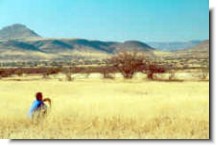
The Kaokoveld is one of Africa's last wildernesses. This is Namibia's least inhabited area. It stretches from the coastal desert plain and rises slowly into a wild and rugged landscape. Here slow-growing trees cling to rocky mountains, whilst wild grass seeds wait dormant on the dust plains for showers of rain
 This is one of the last refuges for the black rhino, which still survive (and thrive) here by ranging wide, and knowing where the seasonal plants grow. It is also home to the famous desert elephants. Some naturalists have cited their apparently long legs, and proven ability to withstand drought, as evidence that they are actually a subspecies of the African elephant. Though this is not now thought to be the case, these remarkable animals are certainly adept at surviving in the driest of areas, using their amazing knowledge of the few water sources that do exist.
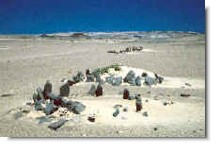 Skeleton Coast. Treacherous fogs and strong currents forced many ships on to the uncharted sandbanks that shift underwater like the desert’s sands. Even if the sailors survived the shipwreck, their problems had only just begun. Skeleton Coast. Treacherous fogs and strong currents forced many ships on to the uncharted sandbanks that shift underwater like the desert’s sands. Even if the sailors survived the shipwreck, their problems had only just begun.
The coast here is but a barren line between an icy, pounding ocean and the stark desert interior. The present road (C34) runs more or less parallel to the ocean, and often feels like a drive along an enormous beach – with the sea on one side, and the sand continuing forever on the other.
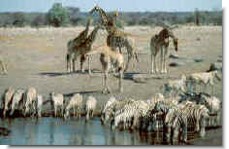
Etosha is an apparently endless pan of silvery-white sand, upon which dust devils play and mirages blur the horizon. As a game park, it excels during the dry season when huge herds of animals can be seen amidst some of the most startling and photogenic scenery in Africa.
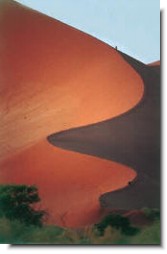
When people speak of visiting the Namib Desert, this is often where they mean. The classic desert scenery around Sesriem and Sossusvlei is the stuff that postcards are made of – enormous apricot dunes with gracefully curving ridges, invariably pictured in the sharp light of dawn with a photogenic gemsbok or feathery acacia adjacent.
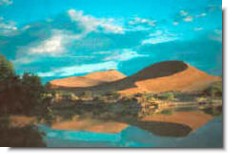
Sesriem and Sossusvlei lie on the Tsauchab River, one of two large rivers (the other being the Tsondab, further north) which flow westward into the great dune-field of the central Namib, but never reach the ocean. Both end by forming flat white pans dotted with green trees, surrounded by spectacular dunes – islands of life within a sea of sand.
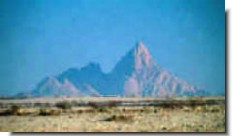 At the far southern end of the Kaokoveld lies a small cluster of mountains, rising from the flat gravel plains that make up the desert floor. These include Spitzkoppe, Klein Spitzkoppe and Pondok Mountains. Of these the highest is Spitzkoppe which towers 600m above the surrounding plains: a demanding technical climb. Its resemblance to the famous Swiss mountain earned it the name of the Matterhorn of Africa while the extreme conditions found on its faces ensured that it remained unclimbed until 1946. |